
 English
 中文简体
中文简体


Engineers and plant operators often wonder whether an Industrial Gate Valve can serve beyond simple on/off duties and actually be used to regulate fluid flow. This question comes up repeatedly on industry forums, technical Q&A sites, and social media as users try to understand how different valve types behave in real process environments and how choices impact system performance. Meanwhile, manufacturers like Zhejiang Xiongxiang Valve Co., Ltd. often receive inquiries about applications where Full Port Gate Valve designs might—or might not—meet flow control objectives.
A gate valve’s basic purpose is isolation: either fully open, allowing fluid to pass with minimal obstruction, or fully closed, sealing the line off completely. This is why many industrial standards and application guides emphasize that gate valves are not designed primarily for throttling or fine flow adjustment.
Core Function: Isolation, Not Throttling
A standard gate valve operates by lifting a wedge or gate vertically out of the flow path when opening and lowering it back down when closing. When the gate is fully raised, the fluid travels in a nearly straight line through the valve, which minimizes pressure loss and disturbance in the flow. When the gate is fully lowered, it blocks the entire flow path, achieving effective isolation.
However, a partially open gate—where flow is intentionally restricted—is not where this valve type excels. The geometry of the sliding gate and seat does not lend itself to predictable, smooth changes in flow area. This means:
- the valve does not provide linear or predictable flow adjustment;
- transient forces on the partially open gate can induce vibration and erosion of the seal surfaces;
- fluid eddies and localized turbulence may occur, increasing wear and reducing service life.
Design standards and industry references note that gate valves generally lack the internal features required for precise throttling. They are engineered for full bore operation, making them effective shut-off devices but inherently unsuited to modulating flow rates.
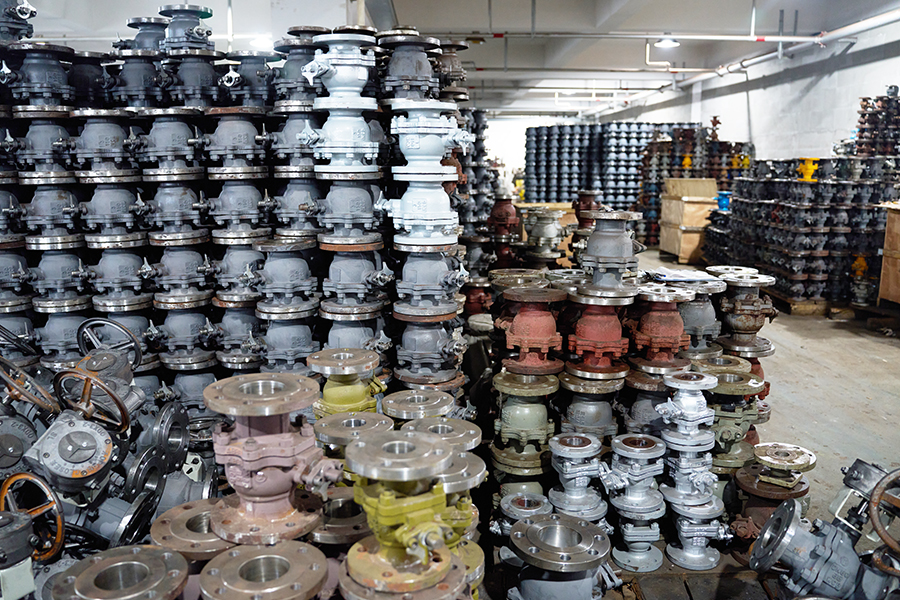
Comparison: Flow Control vs Shutdown
To better understand how gate valves behave compared with specifically designed control valves, think of two categories:
- Isolation valves such as gate, ball, and butterfly valves — designed mainly for starting or stopping flow.
- Control valves such as globe, needle, or diaphragm valves — designed with internal trims to vary flow rate with precision.
Gate valves fall squarely in the former category. While users occasionally operate a gate valve at intermediate positions, doing so invites problems like vibration, seat damage, and irregular flow behavior. Such issues are well documented in forums and technical discussions where users question the reliability of gate valves under throttled conditions.
When Flow Restriction Is Acceptable
There are limited scenarios where slightly restricting a fully raised gate might be acceptable, but they are typically not intentional design choices:
- Emergency system isolation tests, where a slight throttling effect is incidental rather than the purpose.
- Temporary bypass loops, where isolation is more critical than fine flow metering.
- Non-critical fluid systems with low velocity and minimal erosive risk.
Even in these cases, other valve types are usually more suitable where flow rate precision is required.
Technical Considerations for Users
Users should consider several technical parameters when asking whether a gate valve can be used for flow control:
- Flow characteristics: In a partially open state, the sliding gate creates irregular flow geometry, causing non-linear flow responses.
- Pressure drop: A gate that is not fully open will introduce a pressure differential that was not accounted for in system design.
- Material wear: Turbulence and fluid impingement on the gate and seat surfaces accelerate wear—especially in abrasive or high-velocity fluids.
- Valve actuation: Manual wheel operation is slow and unsuitable for frequent adjustments required in real control applications; automated actuators do not change the inherent flow control limitation.
Practical Recommendation
Based on widespread industrial practice:
An Industrial Gate Valve should be used for system isolation, maintenance, and emergency shut-off, but not for routine flow control.
When an application must throttle or modulate flow, operators typically specify valves engineered for that purpose.
Full Port Gate Valve designs, while excellent at maintaining a straight-through flow path when fully open, still follow the same fundamental operating principle and therefore share the same limitations if used for control functions.
Manufacturers like Zhejiang Xiongxiang Valve Co., Ltd. often encourage customers to assess system needs carefully and discuss service conditions to ensure that valve selection aligns with functional requirements.